Month-end close should not be a monthly race against the clock. Yet many accounting teams still depend on spreadsheets, manual reconciliations and last-minute requests concentrated in the first days of the following month.
A better close starts by moving work forward, assigning clear ownership, agreeing deadlines and standardizing supporting documentation. Technology can then help the team focus on exceptions. The objective is a process that is more predictable, accurate and controlled—not simply faster.
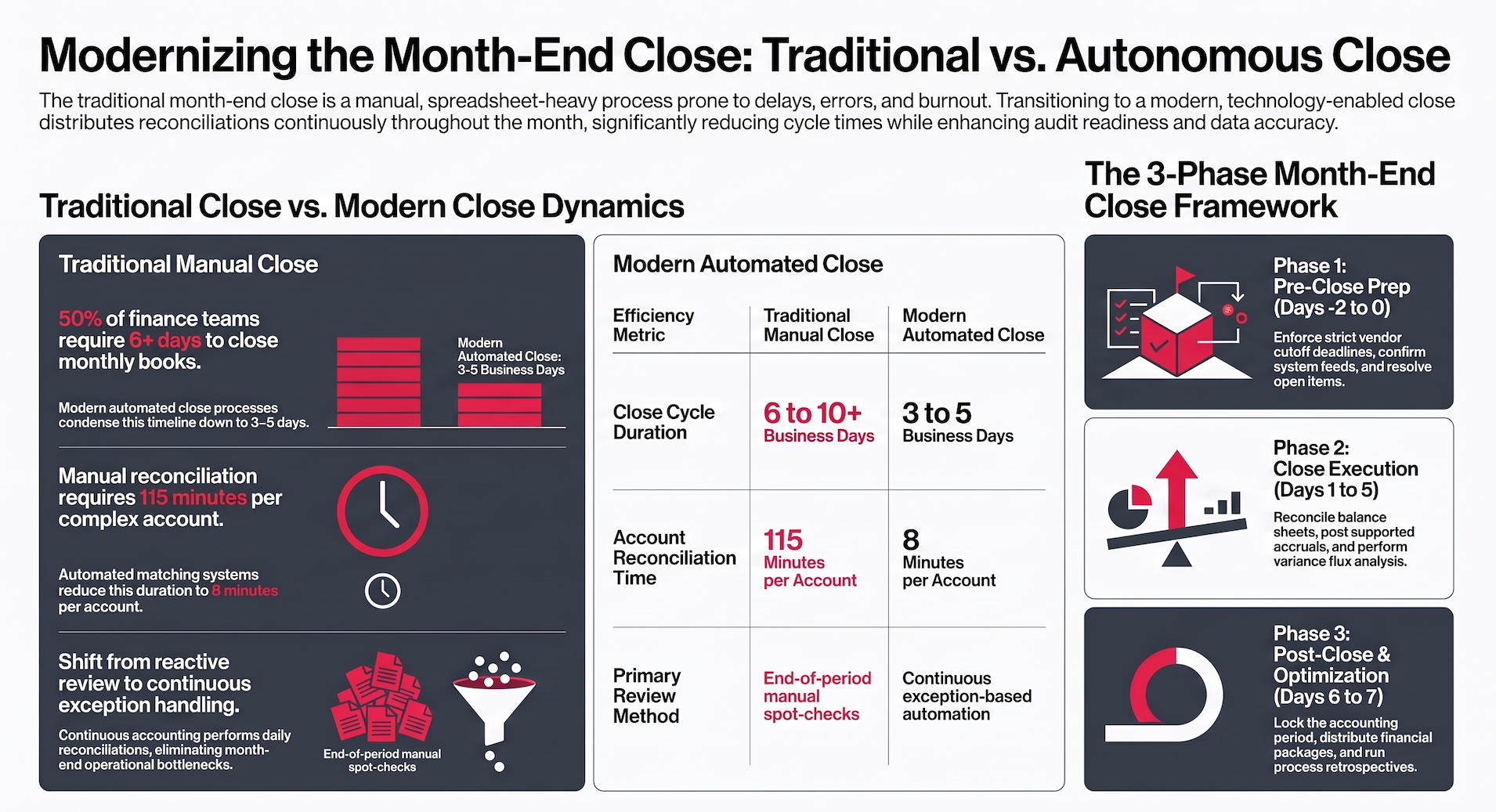
From a Traditional Close to a Modern Close
Traditional closing concentrates accounting activity at period end. Reconciliations, accruals, supporting documents and operational questions accumulate until the books need to be closed. Continuous accounting spreads suitable reconciliations and reviews throughout the month, leaving fewer unresolved items for the final close.
The supporting guide contrasts traditional cycles of seven to ten or more business days with a modern model of approximately three to five. These are illustrative comparisons from the guide, not universal performance targets. Entity complexity, systems, staffing and review requirements shape the appropriate timetable.
| Traditional approach | Modern approach |
|---|---|
| Reactive work at period end | Continuous review throughout the month |
| Scattered spreadsheets and manual handoffs | Integrated systems and defined workflows |
| Unclear responsibility for balances | Named account owners and reviewers |
| Supporting documents collected after close | Digital evidence attached as work is completed |
| Final review bottlenecks | Earlier review and attention to exceptions |
The Four Foundations of a Better Month-End Close
1 Build the checklist around the close cycle
A checklist should follow the sequence of the accounting cycle. The guide organizes work into pre-close, execution, and reporting and final close. Each activity needs an owner, deadline, dependency and required evidence.
Pre-close. Review open purchase orders and AP/AR activity, identify missing invoices, estimate accruals, review recurring entries, investigate unusual balances and confirm operational cutoffs.
Close execution. Complete bank, credit-card and subledger-to-GL reconciliations; record supported accruals, amortization, depreciation and adjusting entries; and resolve balance-sheet reconciliation exceptions.
Reporting and final close. Analyze variances, review financial statements, obtain approvals, distribute the financial package and lock the period. The checklist becomes a workflow with clear completion criteria.
2 Assign account owners and reviewers
Every material balance-sheet account should have an identifiable owner who understands the balance, maintains its reconciliation and follows up on unresolved items. Task assignment alone can leave responsibility for the final balance unclear.
The guide uses RACI to distinguish preparation, accountability, consultation and communication. A practical allocation is shown below; the Controller and CFO should participate according to the organization’s approval structure.
| RACI role | Responsibility |
|---|---|
| Responsible | Prepare the reconciliation, supporting schedules and explanation of differences. |
| Accountable | Review accuracy, cutoff and accounting treatment; approve completion. |
| Consulted | Provide operational information or technical accounting input. |
| Informed | Receive final results and significant exceptions. |
3 Establish real cutoffs and service-level expectations
Accounting depends on information from Purchasing, Sales, HR and Operations. The close calendar should include agreed deadlines for vendor invoices, expense reports and payroll variables, with clear responsibility for each submission.
Each cutoff should answer four questions: What is due? Who provides it? When is it due? How will late information be handled? For example, a late vendor invoice may require an accrual supported by the available evidence and the applicable accounting policy. A submission deadline does not change the period in which an expense belongs.
4 Make every reconciliation audit-ready
A reconciliation is complete when a qualified reviewer can understand the balance and the work performed. Retain the source report, tie-out to the ledger, explanations of differences, supporting schedules, preparer identity and dated review approval.
The guide combines this evidence standard with an ERP period lock and authorized reopening procedures. After the close, hold a brief retrospective to identify delays, recurring exceptions and improvements for the next cycle. Assign an owner and deadline to each action.
A Practical Month-End Close Framework
Use the guide’s schedule as a starting point and adapt it to operational dependencies. Here D0 means month-end; the close calendar should specify how weekends and holidays affect deadlines. The infographic uses a different example timeline, while retaining the same sequence of preparation, execution and follow-up.
| Phase | Key activities | Ownership | Output |
|---|---|---|---|
| Pre-close D−5 to D−1 | Review POs and AP/AR; estimate accruals. | GL Accountant; Accounting Manager reviews. | Exception log and preliminary accruals. |
| Execution D0 to D+3 | Reconcile banks and subledgers; record supported entries. | Account owners; Accounting Manager reviews. | Balance-sheet reconciliations and tie-outs. |
| Reporting D+4 to D+5 | Analyze variances; review and release the financial package. | Accounting Manager; Controller/CFO approval. | Approved financial statements and management report. |
| Governance After approval | Lock the period; control changes; review lessons learned. | Controller and Finance team. | Authorized change record and improvement plan. |
Where Automation Fits
Automation should strengthen the accounting control framework. Useful candidates include transaction matching, recurring reconciliations and journal entries, workflow routing, approval tracking, evidence collection and close-status monitoring.
Define the rules, evidence requirements and review responsibilities before automating. Route unmatched transactions and unusual balances to the appropriate owner. The team can then spend more time investigating exceptions, challenging assumptions and understanding the business.
The Controller Perspective
For Controllers, the close connects reporting reliability, internal controls and management visibility. A well-designed process can provide reliable financial information earlier, support working-capital analysis and reduce the concentration of effort at month-end.
Success should be assessed through both timeliness and quality. A shorter close is valuable only when reconciliations, review and supporting evidence remain strong.
Start Small and Measure Progress
Begin with three higher-risk balance-sheet accounts. Assign a formal account owner and reviewer to each, define the required supporting evidence and introduce an early review. The guide proposes D+2 as an initial review milestone; adapt that timing to the account and the close calendar.
Track a small set of measures consistently, then use each retrospective to decide what to improve next:
- Close duration and late submissions against agreed deadlines.
- Late journal entries and post-close adjustments, including their causes.
- Unreconciled accounts and open reconciliation items, including age and risk.
- Reopened periods and the reasons authorization was needed.
- Manual touchpoints that could be simplified or automated.
Final Thought
A better month-end close starts with a system the team can follow: clear account ownership, realistic deadlines, structured reconciliations and consistent evidence. Continuous review moves work earlier; technology supports repeatable tasks; and the retrospective turns each close into an opportunity to improve.
That is how month-end evolves from a recurring deadline into a reliable financial management process.
Sources and References
Primary source: A Better Month-End Close Starts with a Checklist, supporting guide. See Sections 1–4 and the operating summary matrix for the close comparison, four foundations, phase schedule and implementation steps.
Visual source: Modernizing the Month-End Close: Traditional vs. Autonomous Close, accompanying infographic.
Further reading listed in the guide: Ramp Finance Benchmarks (2025); HighRadius Research (2025); Xenett Operating Model (2026); Numeric Financial Close Report (2025); Prophix / Gartner Study (2024–2026); and Vena Solutions & DocuWare (2025). These labels reproduce the guide’s reference list; they are not presented as independently verified bibliographic citations.